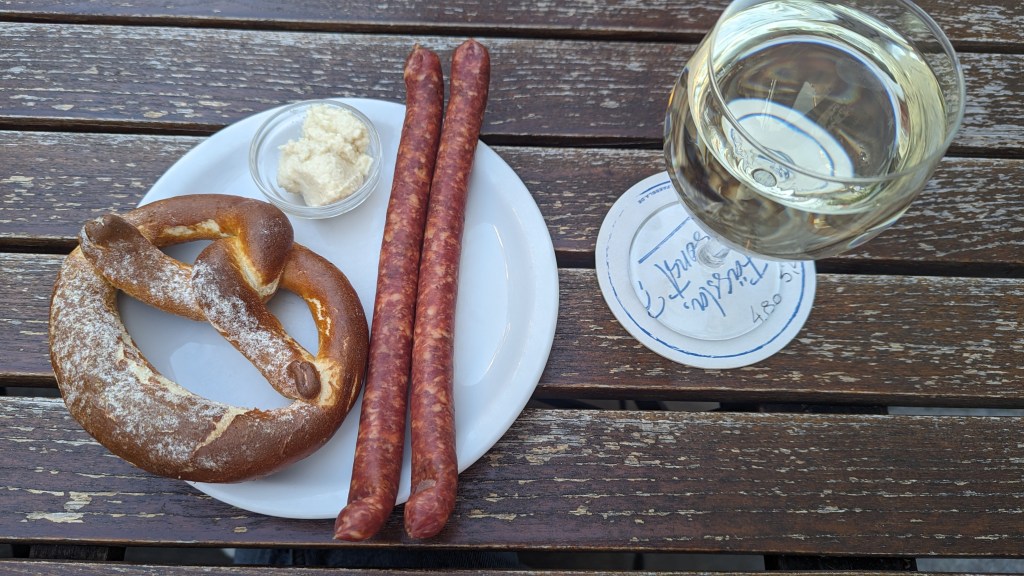
As summer is coming to an end, I think we should all take a moment of reflexion and ask ourselves what defined the summer of 2023 for us: Will you remember it as the summer that gave us King Charles III? Will it be the summer in which Donald Trump was arrested? Or will it be the summer in which German media turned a wild boar into a lion? To me, it will always be the summer that turned my unassuming German Brotzeit into a bold feminist statement.
Wait, rewind! What happened?
It all started earlier this year when Olivia Maher, a 28-year-old showrunner’s assistant from LA, posted a TikTok in which she referenced the assumption that it was awful that Medieval peasants had nothing to eat but bread and cheese and how that was actually her favourite type of dinner. She called it the girl dinner.
While many German TikTok viewers were quick to point out “Err, it’s basically a Brotzeit and we’ve been eating this forever”, a large part of the social media world was quick in celebrating and adapting Maher’s term. The video itself by now has garnered more than a million views and many other content creators started using the hashtag. In the end, girl dinner became so big that it made the New York Times wonder “Is it a meal? A snack? No, it’s girl dinner!”
In the aforementioned NY Times article, Maher explains that the idea of girl dinner came to her while she was on a “hot girl walk” with a friend. The idea of girl dinner is basically that you grab everything that you fancy and arrange it neatly on a plate. To her, it is unlike a “typical dinner” because it doesn’t make you think about the correct ratio of veggies, starch and protein and it doesn’t force you to cook or clean dishes. What’s more important: Girl dinner is to be enjoyed on your own. You don’t assemble food to share – especially not with your boyfriend!
Girl dinner: friend or foe?
The idea of girl dinner was met with lots of criticism from many other TikTokers, who claimed that the portions were often suspiciously small and thereby promoted an unhealthy lifestyle. This backlash was intensified when more and more girls started to go to extremes posting a few single olives, empty plates or only a glass of wine.
But there’s also others – amongst them some nutritionists – who claim that the original idea of the girl dinner is actually a fairly healthy way of eating. Nutritionist Katherine Kofoed remarks that the girl dinner makes you think of your needs and cravings and thereby gives you a feeling of satiation and nourishment.
It is often compared to other social media food trends, which exhibit and promote a more restrictive and diet-based way of eating such as many Meal Prep or What I Eat in a Day videos. One of the most famous examples thereof is Yolanda Hadid’s very realistic and achievable (irony alert!) “What I Eat in a Day”, which stands currently at 7.6 mio. views on YouTube.
But what does my Brotzeit girl dinner have to do with feminism?
When you compare Hadid’s video and a typical girl dinner, it becomes quite clear where feminism fits in. While Hadid personifies the (pre-prison) Martha-Stewardesk flawless housewife and mother, who has no problems balancing her own career and her family’s need for homecooked, nutritious food, the girl dinner does the exact opposite. If food could speak, girl dinner would say: “Hey, it’s ok! Wind down! You just got home from a stressful work day! There’s no need to cook! Just go through your fridge and you’ll certainly find some nice ham and cheese. Pick up a slice of bread and some pickles, make yourself a nice cup of tea and you’re good. Treat yourself, girl! You deserve it!”
Or in the more elaborate words of the New York Times:
Women have long been programmed to see food as the enemy, but the girl dinner trend is about embracing the simple joy of snacks as meals. Girl dinner represents a conscious choice to opt out of the tyranny of cooking and doing the dishes. It’s also, conveniently, the answer to fridge clean out day.
Jessica Roy, New York Times, „Is It a Meal? A Snack? No, It’s Girl Dinner!“
“Katja, you’re 35. Aren’t you a bit too old for girl dinner?”
Every year and as reliable as Christmas, Heidi Klum takes over Thursday night on TV, looking for “Germany’s Next Topmodel” and surrounding herself with her “giiiiirls” (O-Ton: “Meeeeedchen”). Equally as reliable, every year there’s numerous articles online and posts on social media criticising her for the use of the word. Instead they demand of Klum to show respect by acknowledging the candidates as the women they are.
This had me wonder: Am I a girl? Am I a woman? Or do I maybe just need some time, a moment that is mine, while I’m in between?
The Rise of Girl Culture
Fostered by phenomena like the Barbie film or the giant success of Taylor Swift’s Eras Tour, girl culture is really having a moment online. A moment so big that the Spice Girls and their “Girl Power” movement seems like a tiny episode of pop culture history compared to it. But is it a good thing?
Critics argue that the rise of girl culture as seen in girl dinners, hot girl summers or – my personal favourite – girl math (take the test!) is basically a big marketing strategy. A woman’s dinner is sad and boring. It reeks of oat meal or some other mush that you can slurp without teeth. A girl dinner, however, is empowering and fun. A hot woman walk is cringe-worthy and conjures up images of a walking frame while a hot girl walk promotes self-confidence and poise with every step.
Girl culture supporters, however, see women reclaiming some kind of communal safe space that was either taken from them or never there in the first place. After all, it is not the first time that a seemingly derogatory term got reclaimed (e. g. bitch in certain contexts). In her 2016 essay “What Does It Mean When We Call Women Girls?”, Robin Wasserman takes a look at “Girl”-titled books such as “Gone Girl” or “Girl on the Train”. She summarizes:
If there is a thematic message encoded in the “girl” narratives, I think this is its key: the transition from girlhood to womanhood, from being someone to being someone’s wife, someone’s mother. Girl attunes us to what might be gained and lost in the transformation, and raises a possibility of reversion. To be called “just a girl” may be diminishment, but to call yourself “still a girl,” can be empowerment, laying claim to the unencumbered liberties of youth. As Gloria Steinem likes to remind us, women lose power as they age. The persistence of girlhood can be a battle cry.
Robin Wasserman, „What Does It Mean When We Call Women Girls?“
Now, I am neither wife nor mother, and I do not know whether I would still call myself “girl” if I was, but right now the term resonates with me. I do see the marketing part of it and its (naïve?) aspect of fun but I also like that it promises some kind of carefree transitional space, which I can share with likeminded others, who are always in on the joke. I enjoy „doing girl“ just now (to use Judith Butler’s terms), loved dressing up in pink for the Barbie movie and take pleasure in ironically introducing (male) work colleagues to the magic of girl math. In other contexts, quite obviously, I would like to be seen as a woman – more professional, sincere, down-to-earth and maybe even a little boring.
I don’t think it has to be an either-or-thing. I mean, look at where the social pressure to transition from girlhood to womanhood got Britney?

 Couch Potato Chronicles
Hinterlasse eine Antwort zu Isabel Carr Antwort abbrechen