(Ok, brace yourself, here’s a second more „philosophical“ article in a row. I promise the week 2 food and drink review is coming soon.)
I am not really a history buff and even less so when it comes to American history. So, naturally, after arriving in Philadelphia and seeing the large queue for Liberty Bell, I had to do some research. I knew of the bell, but I didn’t really know its history.
I found out that it is commonly accepted that Isaac Norris, speaker of the Philadelphia Assembly, ordered the bell for the bell tower in 1751. What is less commonly accepted is everything that happened thereafter – especially when it comes to the crack.
Some like to argue that the bell was rang, when the Declaration of Independence was first read out in 1776. It makes for a good story but historians today agree that the steeple was in bad condition back then and that the bell cannot have been rung. So where does that story come from? In 1847, George Lippard wrote a fictional piece for The Saturday Currier. In it, a bellman was waiting for the news that Congress had declared Independence. When there was no update, he started to disbelief and doubt that Independence would be declared. However, his grandson was eavesdropping on Congress and finally came back shouting: “Ring, Grandfather! Ring!” The story found wide appeal and was also reprinted in school and history books. It was then that fiction and reality fused. Maybe fiction was just more appealing than the woodworm infested steeple of reality?
Even more myth and story surrounds the infamous crack in the Liberty Bell. Some say, the first crack occurred directly after it was delivered on a test ring. Some say, it cracked when it rang for George Washington’s Birthday in 1846. Some say, it cracked while ringing after the death of Chief Justice John Marshall in 1835. Some even say, it was cracked by the gang from “It’s Always Sunny in Philadelphia”.
The Bell Simulacrum
So, the bell didn’t ring for independence on 4th July 1776 and it is unclear, where the crack is from. Why is it so important then and why does it attract the longest queue I’ve so far seen in the US? (Even the Cronut attracted less people. Sacrilege!) Easy, the bell became a symbol, an icon – or as Postmodernist French social theorist Jean Baudrillard might say, a simulacrum.
In history – after the success of George Lippard’s story for The Saturday Currier – the image of the cracked bell was used by abolitionists during the Civil War striving to abolish slavery, by the Civil Rights Movement, in Vietnam War protests and on many more occasions. It was used by suffragettes, it could be found on coins, it could be found on stamps. The bell came to mean “liberty” (and how convenient that the crack can be seen as the perfect visualisation of how fragile ideas such as liberty, freedom and democracy are!).
According to Baudrillard, simulacra are copies of things that have lost their original or that never even had an original. He claims that a postmodern society has replaced all meaning and “originality” with signs, icons and symbols (simulacra). While in the past, there was a direct connection between the sign and its meaning, this was lost over time. At first, signs and copies were considered untruthful (e. g. the very first photographs – they depicted a reality but they were clearly copies), these copies later pretended to be faithful and “real” (e. g. Andy Warhol’s prints – copies and original at the same time). The last stage is pure simulation, a hyperreality in which we value the sign more than the original. We have acknowledged that there often is no “original” any more and that the sign itself carries value (e. g. taking a selfie in a museum with one of Warhols prints and posting it on Instagram. You’re posing with something that is copy and original at the same time and while the selfie clearly is neither, it still carries symbolic value that you can ideally turn into followers, a modern day currency).
One of the most frequently quoted examples for this last stage of simulation or hyperreality is Disneyland: It doesn’t pretend to be “real” or “authentic”. We don’t expect real castles, real princesses or real pirates. It has value by being pure simulation. It is void of meaning. Its sole purpose is to hide, that all the other signs still pretending to be real are merely signs and signifiers as well (“Disneyland is not real, New York City is.” But isn’t New York City just another giant assembly of signifiers and do they carry “original” meaning outside of themselves or do we merely accept, value and appreciate their symbolic meaning?).
I would claim that the Liberty Bell is basically like Disney Land: Is it the real deal if it was reforged? What does it do to its significance if it didn’t actually ring on Independence Day? And does it even matter or aren’t we all flocking there just to take a selfie with a symbol for the internet? Fun Fact: Disney World has a replica of the Liberty Bell which sits in Liberty Square in the Magic Kingdom. Coincidence? I don’t think so.
Standing in line for crack
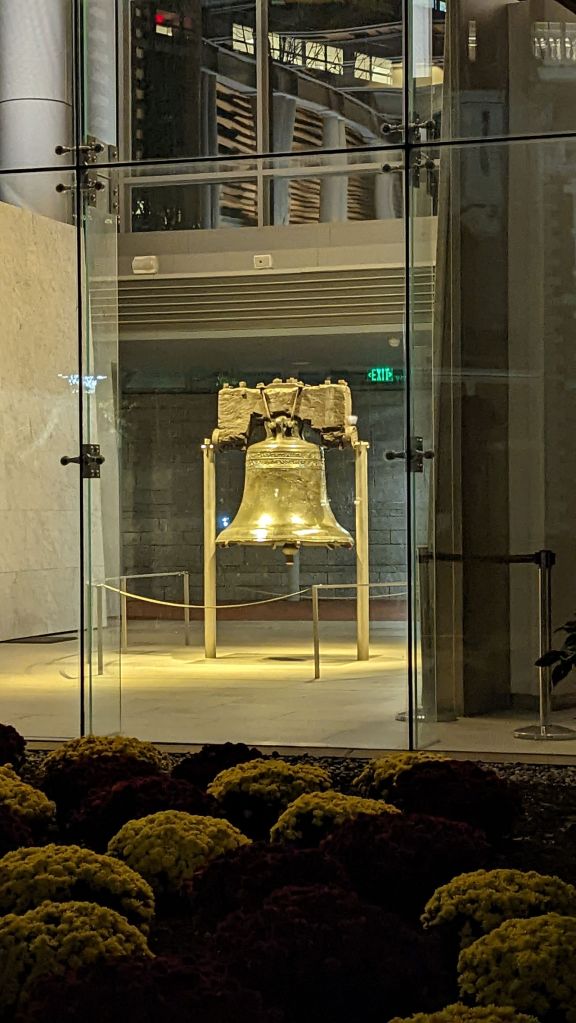
If you now wondered whether I stood in line as well to take a selfie with the Liberty Bell, then I have to disappoint you. Here’s a little pro tip: Liberty Bell can be seen from the outside through glass walls, so I simply stopped by to pay my respects at night, when it was nice and quiet. However, this less touristy approach has a downside as you can’t see the bell’s front. So keep in mind when you’re in Philadelphia: When queuing for the bell, you don’t actually stand in line for the bell. You stand in line for the crack only (pun intended!)
Liberty Bell Trivia:
- The Bell was rung for important events, including the accession of King George III and Benjamin Franklin’s send-off to England. It was rung so many times, that people living close to State House filed a petition in 1772 asking for its removal and claiming that they were “incommoded and distressed” by the “ringing of the great Bell in the steeple”.
- When the Bell first cracked, two Philadelphia foundry workers John Pass and John Stow (not Snow!) tried to fix it but people were displeased with the new sound. So they melted it down and recast it but displeasure continued. The people of Philadelphia then decided to get in contact with England (where the original bell was from) and to have a new bell made and shipped. Upon its arrival, they didn’t like the new bell’s sound either so they kept the recast bell.
- In the 19th century, the Bell toured the US and was shown at numerous expositions. It travelled by train, which resulted in even more cracks. But there was another problem: It became popular with souvenir hunters. By 1909, they had chipped away more than one per cent of the bell’s weight (roughly 9 kg).
- In 1915, suffragettes had a replica of the Liberty Bell cast, called the Justice Bell. This bell had a clapper chained to the ball, so it couldn’t sound, representing women’s lack of a right to vote. When women got the vote after passage of the Nineteenth Amendment, the Justice Bell was brought to Philadelphia in 1920 were it finally rang.
- In 1950, another replica was forged – the Freedom Bell. It first toured the US in a “Crusade for Freedom” and was then brought to Germany, where it still sits in the tower of West Berlin’s City Hall.
- In 1996, the fast food chain Taco Bell announced that it had purchased Liberty Bell and renamed it to „Taco Liberty Bell”. The Bell would be in Philadelphia for half a year and then spend the remaining half of the year at Taco Bell HQ in Irvine, California. People were outraged and thousands called the Independence National Historic Park to protest. Later that day, Taco Bell announced that it was an elaborate April Fool’s Day joke. In that week, Taco Bell’s sales rose by more than half a million dollars.
 Couch Potato Chronicles