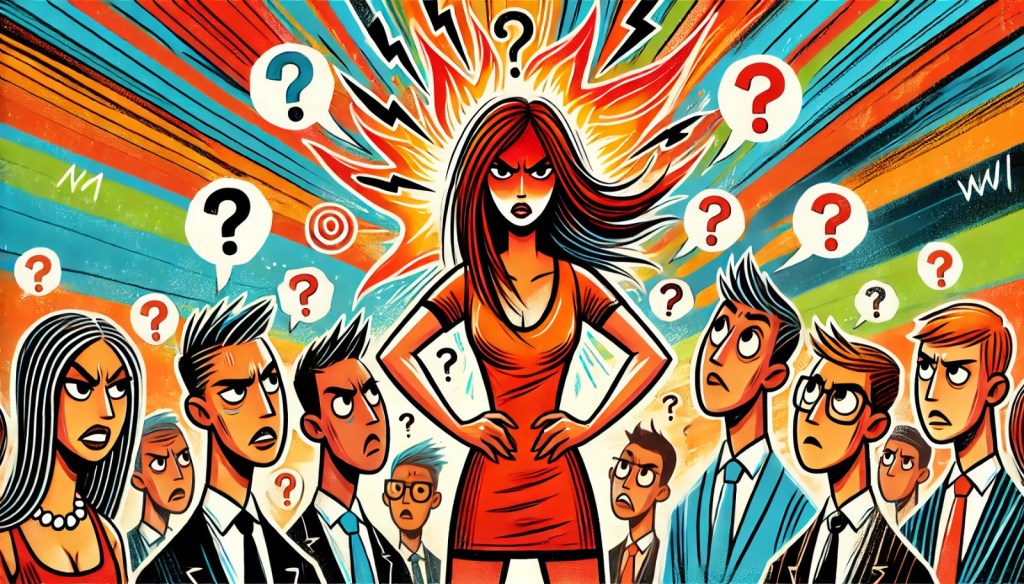
„Are you angry a lot?“, my therapist asked me. „No“, I replied, „I hardly ever get really angry.“ I thought I had given a good answer because my parents had taught me that anger is bad. But when I noticed the tiny flicker of pity crossing my therapist’s face, I started wondering whether I had in fact failed her test. Is anger really something bad? Am I lying to myself when I say that I „hardly ever get really angry“? And why do I think so highly of myself for not expressing anger?
It didn’t take too much introspection to find the answer to the second question: Yes, I am indeed lying to myself. In fact, I am angry a lot – at people who skip the line at the bakery (something that happens to me very often!), at my friends for still making sexist jokes in 2024, at my ex for numerous reasons, at the drug store for charging 15 Euros for the rosegold Venus women’s razor when the men’s blue razor is only 5 Euros
…and then I am angry at the fact that there is a market for something like an overprized rosegold women’s razor…
…and then I am angry at myself for still wanting said rosegold women’s razor.
Coping Strategies
So, what do I do when I get angry? Do I scream? Do I rage? Do I throw things? No, I usually resort to one of two coping strategies to contain my anger:
- Rationalizing The Anger Away: For this strategy, I take a deep breath in, I channel all of my empathy and I detach myself from my feelings. I’m sure the line-skipping people at the bakery simply haven’t seen me. My friends‘ sexist jokes are not that bad, it’s just words. They don’t really mean it. It’s ok if I want the overprized rosegold razor. Me buying it will not result in the downfall of feminism.
- Rage-Crying: Most of the time, coping strategy no. 1 works pretty well for me and I can manage to contain my anger. For the very few instances in which I am really furious and in which rationalizing doesn’t help, my body will go into auto-pilot-mode and take over. Firstly, my whole body will start to shake, then my voice will fail and lastly, I will incontrollably start to weep. It’s literally as if my body tries to contain my inner She-Hulk by channelling all of my emotions into socially more acceptable outlets. Any on-looker – and frequently also the subject of my rage – will perceive me as sad, but not as angry – an emotion that is clearly more appropriate for a woman than rage.
If you have never experienced rage-crying and if my words aren’t precise enough to explain the phenomenon, then I suggest you watch “I, Tonya”, where Margot Robbie gives a great performance of rage-crying. Before figure skater Tonya Harding has to go out to perform at the 1994 Olympics – just after the attack on her rival Nancy Kerrigan – she is seen applying her own make up and being totally overpowered by conflicting emotions, which go far beyond pure and innocent sadness. The pursed lips and the harsh application of make-up to me clearly hint at rage-crying. In the end, she seems to be determined to compose herself and to put on a fake smile – something most women will be familiar with.
(Fun Fact: The scene was not in the script. In an interview, Robbie explained that she was asked to do her make-up for a spontaneous scene. She tried to imagine how Harding must have felt in this situation and was totally overcome by emotion.)
In the past few weeks I thought about anger and female rage a lot: Why do women have such a hard time freely expressing anger? In Rage Becomes Her: The Power of Women’s Anger, Soraya Chemaly claims that kids – and particularly so girls – are hardly ever taught how to be angry. They are taught how to deal with loss, sadness and despair – but not how to deal with anger and rage.
She goes on explaining that “[…] women report feeling anger more frequently, more intensely, and for longer periods of time than men do.” But female rage is interpreted differently than male rage is: “[…M]en more frequently associate feeling powerful with experiencing anger, but women, notably, associate powerlessness with their anger.” According to Chemaly, girls learn at a very early age that anger makes them unlikeable, unattractive and unfeminine. We learn “[t]hat it will twist our faces, make us ugly.”
The Madwoman in the Attic
I firmly believe that such issues are always also represented in culture, so why not go down the female rage rabbit hole.
Sooner or later, every student of English literature will come across Gilbert and Gubar’s seminal work The Madwoman in the Attic: The Woman Writer and the Nineteenth-Century Literary Imagination (1979), in which the authors take a close look at very conflicted, yet very mainstream portrayals of women in nineteenth-century literature. The main argument is that the literary tradition dominated by male writers only knew two female tropes: the angel or the monster. Women were either glorified and put on a pedestal or they were made to represent pure evil. There is no in-between.
When female writers entered the stage, they were still massively influenced by this dichotomous portrayal of women. The most striking example the authors bring forth, is Charlotte Brontë’s novel Jane Eyre (1847). Unbeknownst to the titular heroine of the novel, her love interest Mr Rochester is already married to Bertha Mason. She finds out that shortly after the couple’s marriage, Bertha succumbed to madness and was locked up in the attic. When Jane comes face to face with a fugitive and revengeful Bertha, she flees Thornfield Hall. Later, when she hears Mr Rochester’s voice in her head, she returns to her former home only to find ruins. It is revealed that Bertha has burned down the house in an uncontrollable rage, killing herself in the process.
The message seems clear: Only when the madwoman in the attic is dead, can good Jane Eyre find happiness in marriage with Mr Rochester. Bertha and Jane are two sides of the same medal. Every woman has rage or madness in her but she has to make sure to lock it up, to contain it, to control it – maybe even kill it. Only then will she be rewarded with a fulfilling life.
Female Rage on Film and TV
While portrayals of women in pop culture have become more diverse, I would claim that in terms of female rage the dominating narrative still centres around the necessity to control a woman’s anger. While there are more and more portrayals of female rage, most of those narratives are still often either sexualized and commodified for the male gaze (e.g. Kill Bill, Jennifer’s Body), safely contained within the realm of horror, where anger is mainly pathologized (e.g. Misery, Hereditary) or presented as “rage for a noble cause” (e.g. within the rape revenge genre such as in Promising Young Woman or Take Back the Night).
But what about real female rage? Pure, spontaneous and uncontrolled fury?
Rage-Phoria
Good examples of this can be found in the HBO show Euphoria (2019-), which centres around the lives and conflicts of a group of American high schoolers. Drug addict Rue, portrayed by Zendaya, for instance, is frequently seen in a drug related frenzy. She is seen spiralling out of control and alienating everyone who cares about her in her rage. Anger is commonly regarded as a secondary emotion that usually covers more authentic feelings like sadness, despair or the sense of being violated. This can be seen pretty clearly in Rue’s breakdown, in which she seems to oscillate between rage and fear.
You cannot speak about Rue and rage without also looking at it from an intersectional angle. Being a woman, Rue is expected to hold back her rage. But being a black woman, Rue is simultaneously expected to lose control and to give in to her rage, confirming the “angry black woman” (ABW) trope. In „Mammy, Sapphire, Jezebel, and the Bad Girls of Reality Television: Media Representations of Black Women“, Carolyn M. West paraphrases Melissa V. Harris-Perry explaining, „…because [Angry Black Women’s] passion and righteous indignation is often misread as irrational anger, this image can be used to silence and shame Black women who dare to challenge social inequalities, complain about their circumstances, or demand fair treatment.“ In order to not fit the ABW stereotype, women of colour seem to try even harder to contain their rage, to monitor their body language and to alter their voices. In “Communication strategies across cultural borders: Dispelling stereotypes, performing competence, and redefining Black womanhood”, a black woman interviewee explains the conundrum: “I feel weak as a Black woman if I get angry in class. I’m like, ‘How could you let them get to you?’ But then when I don’t say anything, I feel I’m weak. It’s like a losing battle.”
Aside from Rue, I think that Euphoria also portrays female rage in quite a nuanced way in Sydney Sweeney’s character Cassie Howard. To understand her rage, one has to understand Cassie’s backstory, a tale that is filled with misogyny and unrealistic expectations (most women will be quite familiar with some aspects of it): From her early childhood onwards, Cassie was praised for her good looks. When she was a kid, her father wanted to make her a professional figure skater but ran out of money and stopped paying for her lessons. When she entered adolescence, the men in her family would again reduce her to her outer appearance. After her father leaves the family, Cassie is feverishly seeking male acceptance and uses her looks to foster attention by boys in school. However, they quickly notice Cassie’s naivety and her insecurities and end up objectifying her. In short: she is the hot girl you sleep with to brag to your friends about, but she is not girlfriend material.
Seeking male acceptance at all cost, Cassie is launched into a proper downward spiral when she enters a toxic relationship with her best friend’s ex Nate. She ends up alienating everyone around her and ultimately becoming the villain that everyone made her out to be from the beginning.
In one iconic scene she is seen having a meltdown and giving away all her secrets in a pure and unfiltered outburst of fury. However, at the end of the scene, it is revealed that this meltdown never actually happened. Instead, Cassie swallowed down her rage and kept her composure – as a good woman does.
But as we all know, contained rage will only build up and Cassie ends up having an even bigger public meltdown at the end of season 2. It’s as if Chemaly writes about Cassie in Rage Becomes Her, when she claims: “The lessons are subtle and consistent. We go from being “cute princesses”, to “drama queens”, to “high-maintenance bitches”. Girls who object to unfairness and injustice are often teased and taunted. Adult women are described as oversensitive or exaggerating.”
Brat Summer and Karmic Justice
Ok, so… we’ve established that women often seem to hold back rage because it’s unbecoming but that they actually feel it a lot. Where does the anger go, then?
I would argue that it is often redirected into socially more acceptable channels (see my rage-crying). A current social media trend, for instance, is Brat Summer.
While last year was defined by the Hot Girl Summer, in which we as women were meant to feel good in our bodies and to have our sexual needs fulfilled regardless of conventions, Charli XCX’s album Brat launched us into a new era: we simply don’t care anymore. While last year was dominated by cute summer dresses, a clean girl look, a healthy lifestyle with constant hydration (Stanley cups to the rescue!), this year we indulge in Y2K aesthetic and give a crap about expensive skin care. Who needs that 50€ moisturizer anyway when you’re out partying all night long, sleep in your make-up and pray to God that your concealer will sort out most of the damage on the morning after. Instead of letting out their anger at the world, the social media Brat Girls resort to not giving a f***.
Is it a good thing? Frankly, I don’t know… While I like the overall sentiment and will tell everyone that I am brat now, I have the feeling that it just covers all the reasons women should be angry about and turns rage into a highly aestheticized trend that once again kind of silences us. People who don’t care, don’t start revolutions, right?
Another stand-in for female rage can be experienced on a more interpersonal level as it is frequently directed at the ex boyfriend: the unwavering belief in Karma. Since I cannot seem to write a blog post without referencing Taylor Swift, I will now continue in this tradition. In her song Karma, she sings:
You’re talking shit for the hell of it
Addicted to betrayal, but you’re relevant
You’re terrified to look down
‚Cause if you dare, you’ll see the glare
Of everyone you burned just to get there
It’s coming back aroundAnd I keep my side of the street clean
You wouldn’t know what I mean‚Cause karma is my boyfriend
Karma is a god
Karma is the breeze in my hair on the weekend
Karma’s a relaxing thought
Aren’t you envious that for you it’s not?
Sweet like honey, karma is a cat
Purring in my lap ‚cause it loves me
Flexing like a goddamn acrobat
Me and karma vibe like that
The message is clear: since the singer has always kept “her side of the street clean”, she is rewarded with awesome karma. In contrast, her shit-talking, betrayal-addicted ex will sooner or later be punished by karmic justice – whatever that means.
While Taylor’s lyrics in Karma are pretty tame, music sensation Chapelle Roan brings karmic justice to climax – or rather, vice versa. In My Kink Is Karma, she sings about how her ex boyfriend’s miserable post-break-up-life turns her on sexually (“And you’re getting pissed off, it’s getting me off /
It’s hot, it’s hot, oh god, oh god, oh god.”):
We broke up on a Tuesday
Kicked me out with the rent paid
Ruined my credit, stole my cute aesthetic
Who knew that we’d let it get this bad when it endedIt’s comical, bridges you burn
If karma’s real, hope it’s your turn
I heard from Katie you’re losing it lately
Moved back with your parents and date girls who are 18It’s hot when you have a meltdown
In the front of your house and you’re getting kicked out
It’s hot when you’re drinking downtown
And you’re getting called out ‚cause you’re running your mouthOh, God
And it’s coming around, yeah, it’s coming around
Yeah, it’s coming around, oh, God
Oh, GodPeople say I’m jealous, but my kink is watching
You ruin your life, you losing your mind, you dyeing your hair
People say I’m jealous, but my kink is watching
You crashing your car, you breaking your heart, you thinking I care
People say I’m jealous, but my kink is karma
While I will gladly sing and dance to both of these songs, I cannot help but wonder whether it wouldn’t be better to express anger than to wait for universal justice, as it puts women into a very passive role (see the pattern?). We do not take revenge – the universe will sort it out. We just have to sit back and wait…
Why Is It So Important to Be Angry?
In Rage Becomes Her, Soraya Chemaly writes: “Ask yourself, why would a society deny girls and women, from cradle to grave, the right to feel, express, and leverage anger and be respected when we do? Anger has a bad rap, but it is actually one of the most helpful and forward thinking of all our emotions. It begets transformation, manifesting our passion and keeping us invested in the world. It is a rational and emotional response to trespass, violation, and moral disorder. […] This is the real danger of our anger: it makes it clear that we take ourselves seriously.”
Anger is loud, sometimes aggressive and sometimes even ugly but it is also productive. So why not be a bit more angry?
 Couch Potato Chronicles
Hinterlasse einen Kommentar